





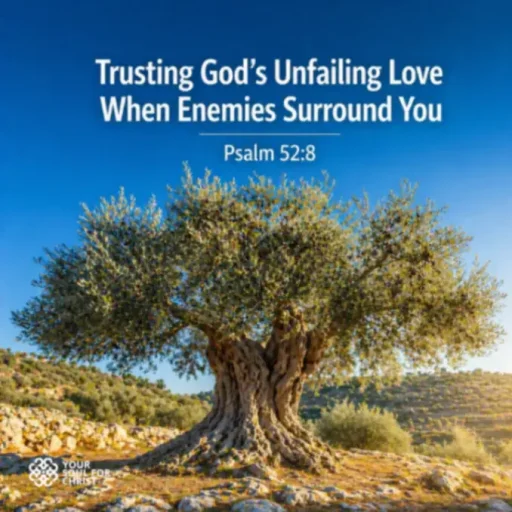
But I am like an olive tree flourishing in the house of God; I trust in God’s unfailing love
Psalm 52:8-9 NIV
for ever and ever. For what you have done I will always praise you in the presence of your faithful people. And I will hope in your name, for your name is good.
There are moments when the very person you trusted becomes the source of your greatest threat. In those moments, the temptation to fight back, defend yourself, or fall into despair can feel overwhelming. Yet, the example of David reveals something far more powerful. Trusting God’s unfailing love is not a retreat — it is the only solid ground when everything else gives way.
When Betrayal Becomes the Test
Indeed, Psalm 52 carries a specific and painful context. The psalm’s heading records that David wrote it after Doeg the Edomite reported him to Saul. Doeg had revealed that David visited the house of Ahimelech the priest. That single act of treachery set terrible events in motion. Saul hunted David. He brought charges against Ahimelech, and Doeg ultimately killed the priests at Nob (1 Samuel 22). David, fully aware of what his visit had cost others, could have responded with bitterness or revenge. Instead, he wrote a psalm.
In verse 8, David makes a declaration that still arrests the soul. He writes: “I am like an olive tree flourishing in the house of God” (Psalm 52:8). Furthermore, he declares his trust in God’s unfailing love for ever and ever. Even so, David chose trusting God’s unfailing love over seeking revenge or fighting for his own survival.
Why Trusting God’s Unfailing Love Produces Flourishing
David had more than one opportunity to take revenge against Saul. He famously spared Saul’s life on at least two recorded occasions. This was not passivity — it was deliberate reliance on the Lord. David refused to fight on his enemies’ terms. Rather, his confidence rested entirely in the unending love of God.
The image of the olive tree is worth examining closely. An olive tree does not wither under pressure; instead, it deepens its roots. Notably, David says he flourishes in the house of God — not elsewhere. The location is crucial. Flourishing cannot happen outside of God’s presence. So it is the direct result of dwelling there.
Yet this dwelling does not mean sitting inside a physical building. Dwelling in the house of God describes a continuous, consistent, and unbroken fellowship with Him. It is a relational habitation — the kind of nearness to God that betrayal, fear, and loss cannot uproot. Trusting God’s unfailing love means choosing to remain in that place, regardless of what presses in from the outside.
Living It Out
God ultimately gave David victory over Saul. The path to that victory was not clever strategy or retaliation. It was complete reliance on God and remaining rooted in His presence. Whatever threatens you today, that same steady path remains open.