





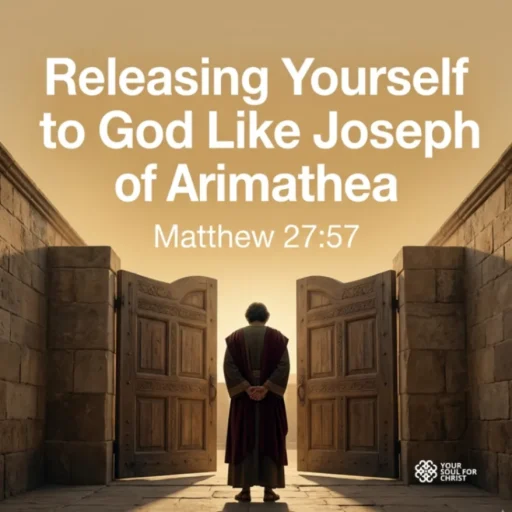
As evening approached, there came a rich man from Arimathea, named Joseph, who had himself become a disciple of Jesus. Going to Pilate, he asked for Jesus’ body, and Pilate ordered that it be given to him.
Matthew 27:57-58 NIV
What does it truly look like when God chooses to use someone? For many believers, the answer feels distant — as though it belongs only to missionaries or people with obvious public ministries. Yet releasing yourself to God is both simpler and more demanding than any of that. The story of Joseph of Arimathea illustrates this clearly. Furthermore, it begins long before the visible moment arrives.
A Disciple Known Only to God
Matthew 27:57 introduces Joseph plainly. The text calls him a rich man from Arimathea who had become a disciple of Jesus. Until that moment, the Gospels had recorded nothing of him. Moreover, he had appeared in no crowd and spoken in no conversation. He had no public profile among the followers of Christ. Nevertheless, the Bible confirms with quiet certainty that he was a disciple — and had been for some time.
However, visibility does not validate discipleship. Joseph had not announced himself. He had not sought recognition. Yet his faithfulness was as real as that of any of the Twelve — it simply had no public record. He remained steady in his relationship with Christ, trusting that his moment would come.
Why Releasing Yourself to God Is the Beginning of Everything
In Matthew 21:2–3, Jesus sent two disciples ahead to collect a young donkey tethered outside a village. It had never carried a rider. It was simply there — tethered, waiting, available — until the Lord called for it. Joseph of Arimathea, similarly, grasped this posture. He had allowed God to hold him in reserve, much like that donkey. He waited for the specific moment when the Lord would have need of him.
Importantly, his wealth and high standing never became a barrier. Indeed, they were the very resources God intended to deploy. Releasing yourself to God does not require you to be poor, unknown, or without influence. It requires only that you hold all of it loosely, ready for God to direct it at will.
Mark 15:43, moreover, adds a detail the other Gospels leave out. When Joseph went to Pilate, he went boldly. As a counsellor and prominent member of the Council, he had status. He had access that ordinary followers lacked. So rather than shrinking from a politically dangerous request, he walked straight into Pilate’s hall. He asked for the body of Jesus. His position, his reputation, and his relationships — none of these pulled him away from Christ. Instead, they all served Christ in the decisive hour.
Ultimately, this is the posture God seeks. Not perfection, not public ministry credentials, not spiritual celebrity. Rather, it is the person who has quietly remained close to Christ. That person stays available within whatever position they hold — and steps forward without hesitation when God calls.
Living It Out
Consider where God has placed you — your resources, your access, your connections. Releasing yourself to God means holding all of it loosely — not as personal property. Hold it as a vessel He can ride upon whenever the moment comes.