





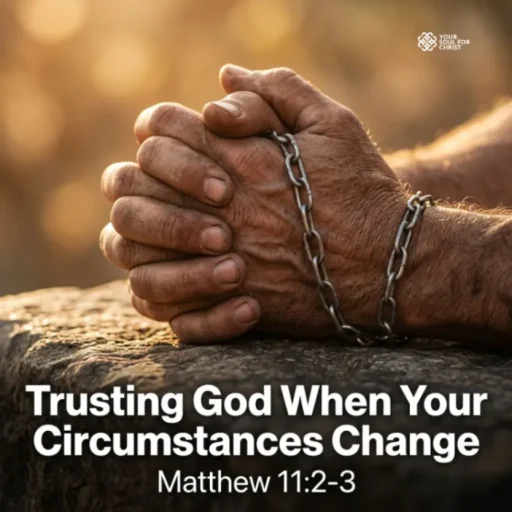
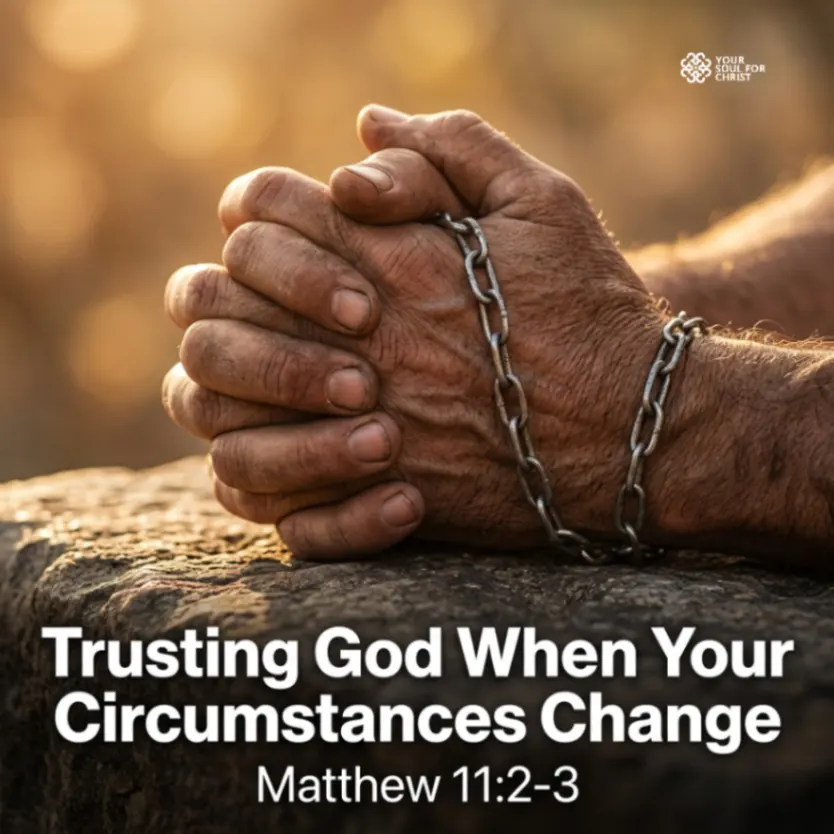
When John, who was in prison, heard about the deeds of the Messiah, he sent his disciples to ask him, “Are you the one who is to come, or should we expect someone else?
Matthew 11:2-3 NIV
There is a profound lesson for all of us here about trusting God when your circumstances change. In Matthew 11:2-3, John the Baptist was in prison. From his cell, he sent his disciples to Jesus with a pressing question. “Are you the one who is to come, or should we expect someone else?”
This question is surprising — and yet deeply instructive. John was no ordinary observer. He was the man who had baptised Jesus, standing at the water’s edge as the Spirit of God descended upon him. God’s own voice had come from heaven: “This is my beloved Son, in whom I am well pleased” (Matthew 3:16-17). Furthermore, John had seen Jesus with his own eyes and proclaimed him publicly: “Behold, the Lamb of God, who takes away the sin of the world” (John 1:29). He had told the Pharisees plainly that he was not the Messiah. Moreover, he had spoken with certainty that another was coming — one far greater than himself.
Yet here he was in a prison cell, still asking: is this really him?
When Chains Create Doubt
Even from prison, John was hearing about the deeds of Christ. The miracles, the healings, the transformed lives — in fact, all of it was reaching his ears. As a result, he had every reason to recognise Jesus as the Messiah. No ordinary person could do what Jesus was doing; consequently, only the promised one could operate at that level. The evidence had not disappeared. However, John’s circumstances had. He was now in chains. And with those chains came doubts he had not anticipated.
Perhaps John had assumed that following the Messiah so closely would shield him from suffering. Maybe he expected that proclaiming Jesus would change his own situation. Yet it had not. And so, instead of resting in what he had personally witnessed, doubt began to move in. Because the Messiah was not meeting his circumstances in the way he had hoped, John’s certainty began to waver.
Trusting God When Your Circumstances Change
This is where the mirror turns toward us. How many times have we been in John’s place — uncertain, not because God has changed, but because our lives have? John’s faith did not waver because God had removed any basis for trust. Indeed, all the evidence was still intact. His faith wavered because things were not going the way he had expected.
God’s prophecy had not changed. Jesus had not changed. What had changed was John’s situation — and with it, his perspective.
Similarly, we can find our confidence shaken not by God’s failure, but by unmet expectations. We expect that trusting God will smooth the road. Surely obedience should prevent suffering. Yet sometimes God’s path leads through prison before it leads to freedom.
The shift required of us is not merely a change of mind. It is a deeper surrender. We must come to a settled understanding: life may not go the way we desire, but that difficulty is still part of the script God is writing. Therefore, we must willingly and humbly submit to him — embracing all the challenges that come with following God, without doubt or uncertainty.
Living It Out
Following God means embracing every part of the journey — including the chains, the confusion, and the unanswered questions. Trusting God when your circumstances change is not passive resignation. It is an active, humble submission to the one whose plan has never wavered.